AEO Visibility Engine · audit, deploy, track

See who AI recommends instead of you.

Ask ChatGPT, Perplexity or Gemini who to hire in your category and a short list comes back. The Visibility Engine finds out who is on it, why, what they say that you do not, and which pages you need to be on. Then our team of engineers fixes it and tracks the result.

AI Visibility Audit · competitors AI names
CompanyLists it is onWhy it competes
Example Co. ATier 1 · direct9 of 14Same service, same city, same buyer
Example Co. BTier 1 · direct7 of 14Leads with the term buyers search
Example Co. CTier 2 · adjacent4 of 14Different size, overlapping offer
YouNot listed0 of 14Missing from the pages AI cites

Illustrative example. Your audit uses your real category, city and the pages AI engines actually cite.
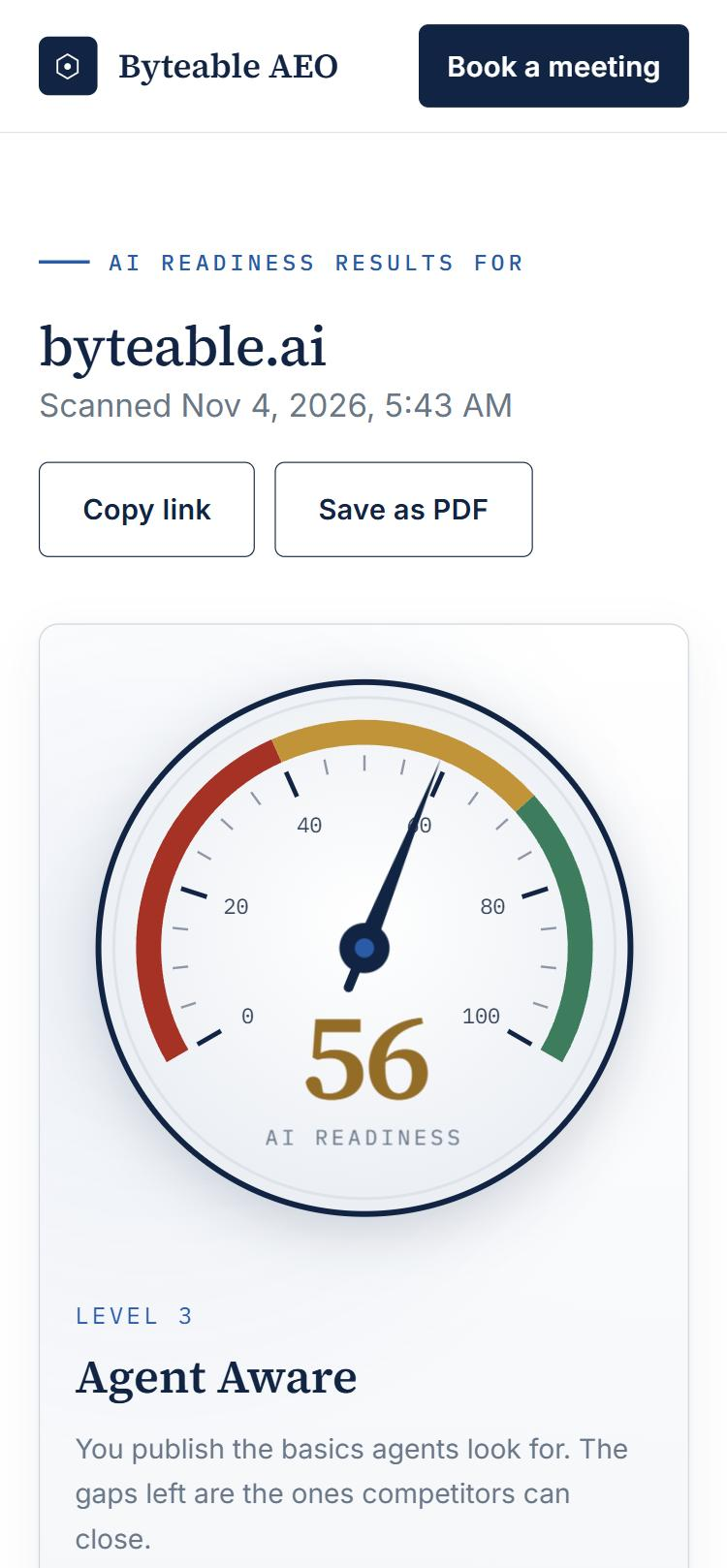

A scan result on a phone: score 56 out of 100
Tier 1 mapped Not on 14 lists
The audit

Four questions. One bespoke report.

Every client gets a report written around their own market. It answers the same four questions, with the evidence behind each answer.

1

Who does AI think your competitors are?

The companies named on the “best in your category” lists and directories that ChatGPT, Perplexity, Gemini, Google AI Overviews and Copilot cite for your category and location.

2

What do they say that you do not?

A word-for-word comparison of their sites against yours: titles, headings, services, locations, proof. The terms buyers search that you never use.

3

What should you change on your site?

A prioritized table of changes, each with the exact words to use, what is on your site today, and whether it is a quick fix.

4

Which pages should you get onto?

The third-party lists worth being on, who runs each one, and outreach written in your own voice.

How it runs

Audit. Deploy. Track.

The audit is where it starts, not where it ends. A report that sits in a folder fixes nothing, so the work continues until the changes are live and measured.

1

Audit

We map the landscape and write the report.

  • Cited pages and competitors from live AI answer data
  • Term comparison against your closest competitors
  • Prioritized changes and a target list
2

Deploy

Our team makes the changes with you.

  • Titles, headings and pages rewritten around searched terms
  • Technical files for AI agents published
  • Directory profiles claimed, outreach prepared
3

Track

Results are measured in your dashboard.

  • How often AI engines name you, week by week
  • Which changes moved which questions
  • Gaps that remain feed the next round
What the report contains

A change table you can hand to a developer.

The heart of the report is a list of changes in priority order. Every row says what is on your site today, what to change it to, and why it matters. The rows below are an illustrative example for a local service business.

ThemeCompetitors using itSearches / moOn your site todayRecommended changePriority
Location in the title8 of 102,400“Solutions that scale”Lead the title with the service and the cityHighQuick
Industry pages6 of 101,300Industries appear only in a widgetOne indexable page per industry you serveHigh
Proof that matches the buyer5 of 10n/aEnterprise testimonials for a small-business offerAdd results from clients your buyer resemblesMedium
US-based team7 of 10720Not statedState it, once you confirm it is trueConfirm first

The full report

  1. Bottom line. Three to five sentences from a strategist.
  2. Who AI thinks your competitors are. Direct competitors, adjacent ones, and what was excluded and why.
  3. What they say that you do not. The change table above.
  4. Start here. The two or three changes to make first.
  5. Pages to get onto. Target lists and the directory profiles to claim.
  6. Outreach plan. Copy in your voice and a ready-to-paste listing entry.
  7. Method and limits. Data sources, dates and known gaps.
  8. Sources. Every page the report relies on.
Deeper than the free scan

The scan samples. The audit proves.

The free scan checks your homepage and a handful of links against public standards. The audit goes through the whole site, your reputation off it, and what AI engines really say about you.

Technical depth

Everything the free scan samples on one page, checked across the whole site.

  • Crawler log evidence, where your server logs can be connected: which AI bots actually fetched your pages, and which they skipped
  • Indexing and canonical audit of every page, not only the homepage
  • Structured data coverage by page type: Service, LocalBusiness, FAQ, Review, Person
  • JavaScript rendering test: what each page looks like to a crawler that runs no scripts
  • Redirect chains, broken links and orphan pages across the site
  • Page speed and core web vitals, measured at the pages AI cites

Entity and trust

Whether engines can confirm who you are, and believe it.

  • Name, address and phone consistent across Google Business, directories and your own site
  • Review volume and rating on the platforms buyers and engines read
  • Author, credential and About pages that show real people and real expertise
  • Third-party mentions of your business, and from whom
  • Brand-name confusion with other companies or products
  • Wikipedia, Wikidata and Crunchbase presence where it applies

AI answer analysis

What each engine actually says about you, question by question.

  • Your answer on ChatGPT, Perplexity, Gemini, Copilot and Google AI Overviews for each tracked question
  • Accuracy check: wrong facts, outdated claims and missing services in what AI says
  • Share of voice against your closest competitors, by engine and by topic
  • The sources each engine cites, ranked by how many answers they shape
  • Sentiment: whether you are recommended, merely listed, or warned against
  • Monthly re-run with alerts when an answer about you changes

Every one of these is measured, stored and traced to a source, so each change in your report points back to the evidence for it. Run the free scan first to see where you stand.

Who does the work

Machines gather. People check. A strategist decides.

Most of an audit is routine: pulling data, reading pages, counting words. We automate that, have our team of five trained engineers verify it by hand, and keep a senior strategist for the judgment calls that make the report yours.

Every number traces to a source

Each figure in the report points back to a stored data pull, so it can be checked.

Competitors are verified by a person

A human confirms each company is real, local where it claims to be, and actually competes with you.

Your positioning is never guessed

The strategist writes your category in one sentence, approves the competitor set and signs off the report.

Automation

Pulls and counts

Cited pages, page fetches, term counts, keyword volumes, first drafts.

Engineering team of five

Verifies

Competitor details, extracted data against the live page, contacts, quality checks.

Strategist

Decides

The category, the competitor set, the priorities, the bottom line, and every approval.

Guardrails

What we will never do.

Optimization work touches your reputation. These rules are built into how the Engine runs, not promised in a sales call.

Invent a claim

Nothing about your team, results, pricing or certifications appears in copy unless you confirmed it in writing. Anything that depends on an unconfirmed claim is marked “confirm first”.

Send without approval

No outreach goes out, no sequence starts and no spend happens until a strategist approves the exact list and cost.

Buy a placement quietly

Any publisher that asks for payment is flagged. There are no undisclosed paid placements.

Mix clients

Your data, contacts and report are stored separately from every other client’s. Competitor lists may overlap, but they are kept per client.

Works with the Content Engine

The gaps become the next articles.

The audit finds terms, industry pages and proof you are missing. Those become briefs the Content Engine writes up, publishes and promotes on LinkedIn. Both run from one dashboard, so you see what AI says about you in one place.

Auditfinds the gap
↓
Briefsent to the Content Engine
↓
Article + postspublished and scheduled
↓
Dashboardshows if AI now names you
Justin Sweeley, founder of Byteable
Justin Sweeley, PhDChemical engineer. Founder and CEO, Byteable. Based in Phoenix.
Who we are

Why a chemical engineer runs your AEO.

I am a PhD chemical engineer with 20 years of experience designing some of the most sophisticated medicine products in the world.

The process design mentality behind countless cancer therapies and COVID vaccines is the one we now apply directly to your business. In that world a process that works on Tuesday but not on Friday never ships. We hold your visibility to the same standard: find where the process breaks, measure it, fix it, and prove the fix worked.

  • Research backedEvery step rests on published standards and live AI answer data, not hunches.
  • QuantifiableEvery claim traces to a number. If we cannot measure it, we do not promise it.
  • Adapted dynamicallyResults feed back into the plan, so your business keeps following state of the art best practice as it changes.
  • PhD, Chemical Engineering
  • 20 years in pharmaceutical process development
  • Founder and CEO, Byteable
Pricing

Start with the audit.

The audit comes first, then deployment and tracking. Pricing is confirmed on your call with Justin, before you commit to anything.

1. The audit

The bespoke report, built around your market.

  • Competitor landscape from live AI answer data
  • Term comparison and prioritized change table
  • Target list and outreach copy in your voice
  • Shareable page plus a PDF
Book a meeting
Then

2. Deploy and track

The fixes made, and the results measured.

  • Site changes deployed by our team
  • Directory profiles claimed and listings pursued
  • Weekly tracking in the same dashboard as the Content Engine
  • Remaining gaps become the next round
Book a meeting

We do not promise rankings or a number of leads. We promise a verified audit, the changes made, and a weekly view of what AI says about you.

Straight answers

The questions on every call.

The Visibility Engine fixes what you already have and finds what you are missing: your site, your listings and the lists AI cites. The Content Engine creates new articles and posts every week. They share one dashboard, and the audit feeds the Content Engine its briefs.
From the pages AI engines cite when buyers ask about your category and city. We read those pages, list the companies on them, and a person verifies each one before it goes in your report.
Only with your approval. The report lists the pages worth being on and drafts the outreach in your voice. Nothing is sent until you approve the exact list. Any publisher asking for payment is flagged, never hidden.
No. The report is written for a business owner, and each change comes with the exact words to use. Our team can make the changes for you if you give us access to your site.
A short intake: your site, your market, the competitors you already know, and a few facts you confirm in writing, such as where your team is based and results you can share. If you have a podcast, talk or writing in your own voice, we use it for the outreach copy.
The audit is a deliverable, so you see it first. Results from changes take weeks, because AI engines have to find and use the updated pages. We will not pretend otherwise, and the dashboard shows movement as it happens.
Next step

Find out who AI recommends instead of you.

Start with the free scan to see how ready your site is today, then add the Visibility Engine when you are ready.

Audit firstVerified by peopleNothing sent without your approval